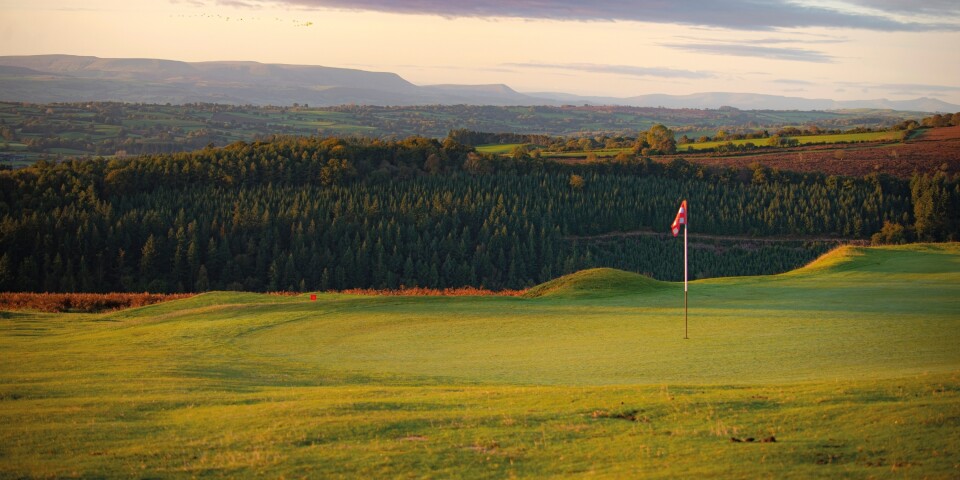
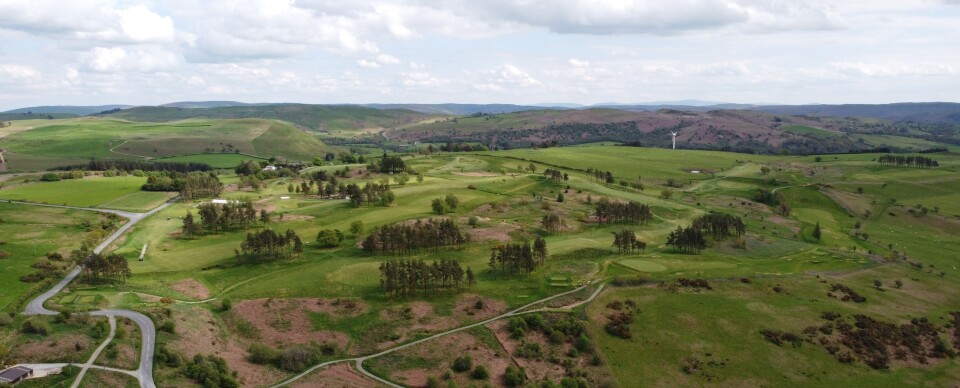
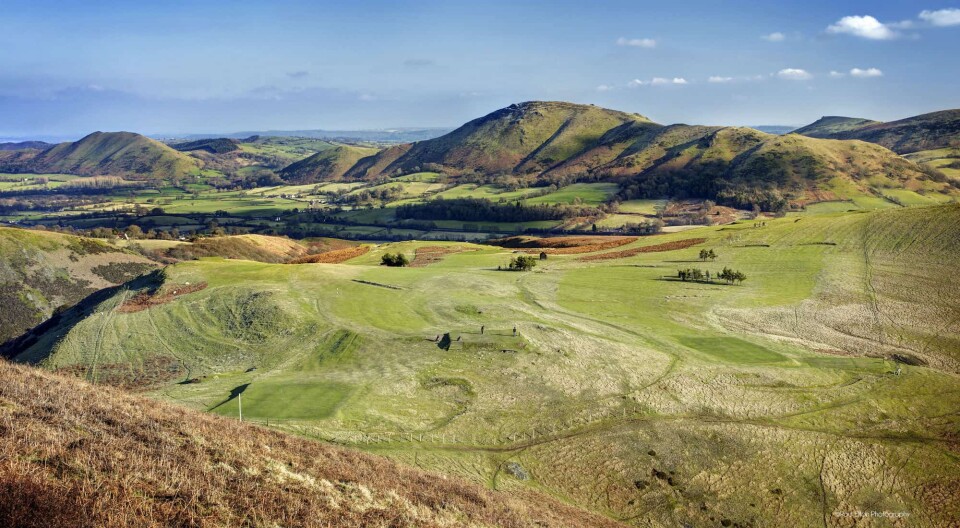
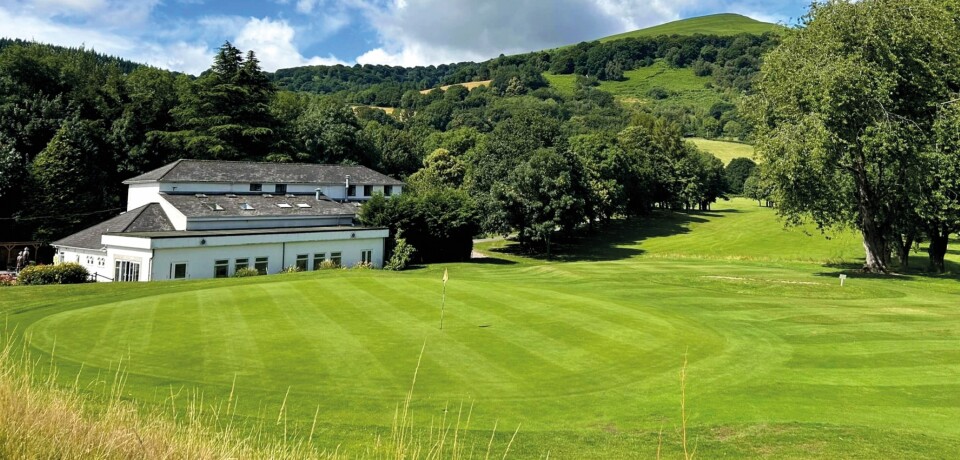
The key number is 1,284 – that's how many feet Kington is above sea level. Remember that as your ball might travel slightly further on a good day! The land here is pretty much a thin layer of turf and then rock, so year-round playability from the fast-draining soil is a big selling point, with no temporary tees or greens. The uphill holes at this moorland course play longer than their yardage, while elsewhere the greens are well-defended, sneakily slopey, and outstandingly quick. There are no sand bunkers at Kington – but plenty of grass ones, and it's under 6,000 yards from the back tees at Kington. With a par of 70, you shouldn't expect a collection of birdie chances. And then there are the views. They are on all sides, including a magical panorama towards Wales and the Brecon Beacons from the 9th tee at the furthest expanse of the course.
The opening hole is gentle despite playing uphill, at only 313 yards from the tips. Take an extra club to make sure you don’t come up short of the 1st green. The 2nd is also relatively short, but with a narrow fairway, the safe bet is a long iron off the tee. The first of the five par 3s at Kington comes at the 3rd, which is 160 yards and played across a large hill. There is a bank to the right and back of the green which can be used to run the ball back down the green if you take a club extra...
The 4th is one of just two par 4s at the Herefordshire venue which is over 400 yards. At 421 yards, it requires a full-blooded driver to put you in reach of the green, which is two-tiered, so make sure you find the right section. 5 is another short hole, playing slightly uphill, which makes it more than its carded yardage of 150. The 6th features out of bounds down its right side, so those with a tendency to slice the ball with driver should opt for a lesser club. 6 is less than 340 yards, so driver is not necessarily required.
The first of the three par 5s on the course comes at the 7th. The tee shot is completely blind, so you need to aim at the marker post. Find the fairway and the green may well be in reach with your second shot as the opening par 5 is only 470 yards from the tips. The 8th is the most difficult hole at Kington, playing 433 yards and usually into the prevailing wind. Grass bunkers surround the putting surface, making it a true links test. The final hole on the front nine is the shortest hole on the property. A large slope to the right of the green means that the miss is left on this 137-yard par 3.
Another blind shot comes into play off the 10th tee. At just 320 yards, the very longest of hitters might fancy taking this on, but most will end up with a wedge in hand, playing to another two-tiered green. The first of two par 5s on the back nine at Kington comes at 11, and it will require two big hits to reach. Most will be on in three, as long as they miss the cross-grass bunkers. At 193 yards, and with a green that is 35 yards long, the 12th can be anything from a mid-iron to a driver or 3-wood, depending on the wind direction. 13 is the hardest hole on the back nine, mainly due to the fact that anything left is in trouble, severe trouble! It is 380 yards, so driver is not necessarily the best play, but the approach must stay right of the green.
The 14th is the longest hole at Kington, coming in around the 550-yard mark. It plays slightly downhill so you can see everything in front of you, but it will remain a three-shotter for most. The view from the 15th, like the 9th, will entice most into losing concentration. When you’ve got that back, you’ve got a 215-yard par 3 to deal with. It does play downhill, so you are also at the mercy of the wind. 16 and 17 are both around the 330, 340 mark, meaning driver again, is not necessarily the play. The course comes to a conclusion with the glorious 280-yard 18th – do you go for it? Or do you lay up to a safe distance?